
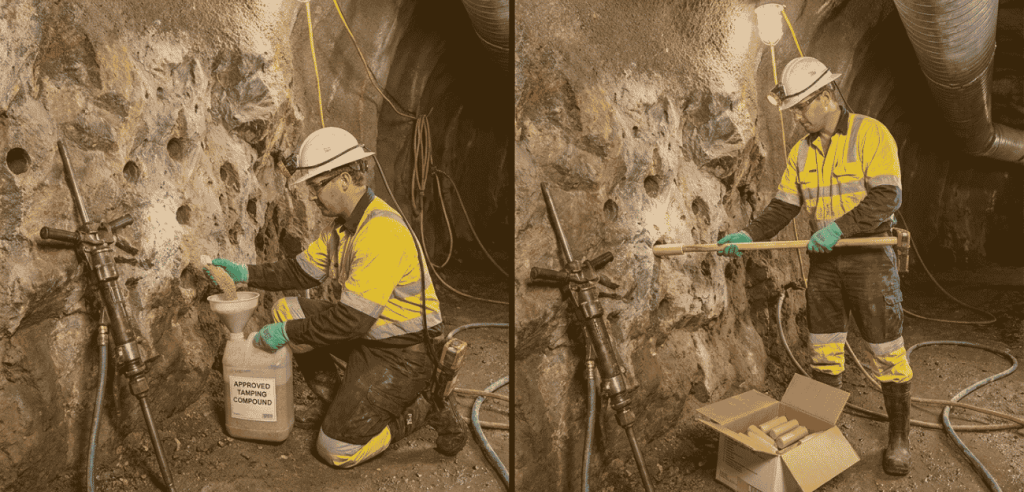
The main difference between bulk tampings and capsule tampings is how the stemming material is packaged, delivered and placed inside the blast hole.
Bulk tamping is supplied as a loose or free-flowing compound that is loaded directly into the hole. Capsule tamping is supplied in pre-packed, measured units that are inserted and compacted to form the stemming column.
Both formats have the same fundamental purpose: to seal the charged section of the blast hole, restrict the premature escape of explosive gases and help the blast energy act on the surrounding rock. Effective stemming supports energy confinement, fragmentation control and more predictable blasting performance.
However, neither option is automatically suitable for every operation. The correct choice depends on the shot-hole dimensions, hole orientation, loading method, working environment, required consistency and the mine’s approved blasting procedure.
What Are Bulk Tampings?
Bulk tampings are loose stemming compounds supplied in the form of chippings. The material is poured, transferred or mechanically loaded into the uncharged section of the blast hole and then compacted according to the mine’s procedure.
Depending on the product and application, bulk stemming may consist of:
- Crushed aggregate
- Screened mineral chips
- Sand or clay-based material
- Drill cuttings
- Engineered mineral blends
- A combination of wedging particles and binding material
The important distinction is that the material is not divided into individual cartridges before it reaches the hole.
Research into stemming practice shows that the material type, particle characteristics, stemming length and quality of placement can all influence the effectiveness of the stemming column. Loose drill cuttings, for example, do not necessarily perform in the same way as purpose-selected crushed aggregate or an engineered mineral compound.
Advantages of Bulk Tampings
Bulk material can provide mines with:
- Flexibility when filling different stemming lengths
- Compatibility with manual or mechanical loading systems
- Efficient loading where suitable bulk equipment is available
- The ability to fill the available section without counting individual units
- Practical supply for operations consuming high volumes of stemming material
Bulk tamping can be particularly useful when the mine already has an established method for measuring, transferring and compacting the material.
Factors to Control When Using Bulk Material
Although the manufactured compound may be consistent, the final installation can be influenced by the person or equipment loading it. The mine must therefore control:
- The quantity loaded into each hole
- Compaction between loading stages
- The completed stemming length
- Material loss or contamination
- Moisture and hole conditions
- The loading equipment used
Bulk tamping does not automatically produce inconsistent results. Nevertheless, it generally places more responsibility on the loading process to achieve the required column density and length.

What Are Capsule Tampings?
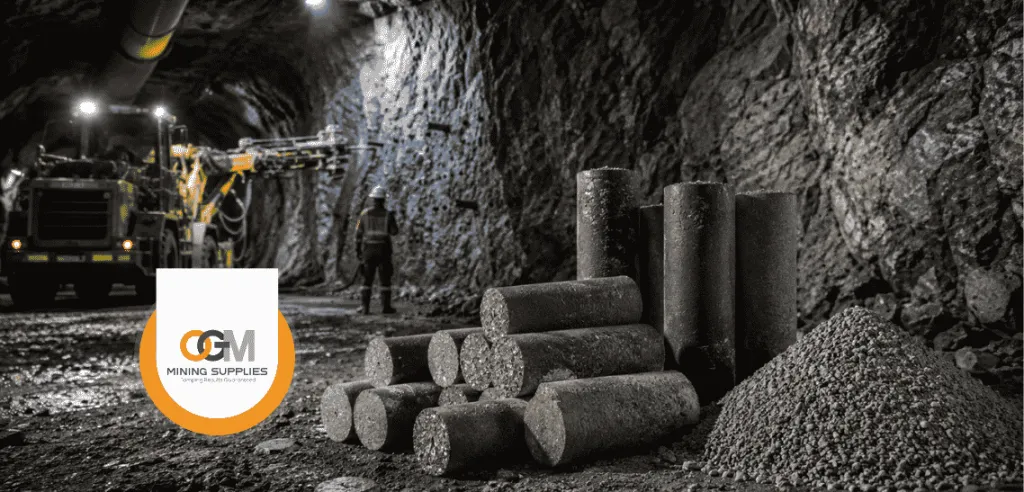
Capsule tampings are pre-packed stemming units manufactured to defined dimensions. The material is contained inside a sleeve or cartridge and supplied in sizes selected for particular shot-hole diameters.
The capsules are inserted into the hole and pushed or compacted into position using the mine’s approved equipment and procedure. Once placed correctly, the units form the required stemming column above the explosive charge.
A capsule may contain clay, sand, mineral aggregate, binders or an engineered combination of materials. The exact composition depends on the manufacturer and intended mining application.
Advantages of Capsule Tampings
Capsule products can offer:
- Pre-measured units
- Controlled product dimensions
- Cleaner handling around the working area
- Reduced loose-material spillage
- Easier stock counting and issuing
- More repeatable loading between blast holes
- Straightforward matching to approved hole diameters
Because every capsule is supplied as a defined unit, blasting teams can calculate how many units are required to achieve the specified stemming length.
However, the packaging alone does not guarantee a successful seal. The capsule must still suit the hole diameter, be inserted correctly and be compacted according to the approved blast design.
Bulk Tampings vs Capsule Tampings: Key Comparison
| Comparison point | Bulk tampings | Capsule tampings |
|---|---|---|
| Product form | Loose or free-flowing stemming compound | Material contained in pre-packed units |
| Application | Poured, transferred or mechanically loaded | Inserted individually and compacted into position |
| Measurement | Quantity must be measured during loading | Each unit has predetermined dimensions |
| Stemming length | Adjusted by adding the required volume | Built up using a calculated number of capsules |
| Placement consistency | Depends strongly on measuring and compaction control | Pre-sized units can support more repeatable placement |
| Handling | May involve loose-product transfer and spillage control | Contained format generally supports cleaner handling |
| Hole sizes | Can offer flexibility across varying stemming lengths | Capsules must be matched to the relevant hole diameter |
| Inclined holes | Retaining loose material may require an appropriate loading method | Contained units can simplify placement in certain inclined applications |
| Loading equipment | Suitable for manual or mechanical loading | Generally inserted with an approved loading stick or system |
| Inventory control | Managed by mass or bulk quantity | Managed by unit count, size and batch |
| Customisation | Blend and particle grading may be adjusted | Diameter, length and material blend may be adjusted |
| Best suited to | Operations equipped for controlled bulk loading | Operations prioritising pre-sized units and repeatable handling |
How Does the Application Method Affect Performance?
The difference between bulk and capsule tamping is not simply a packaging decision. The format changes how the product is measured, handled and installed underground.
Measurement and Stemming Length
With bulk tamping, the operator or loading system must introduce the correct quantity to produce the specified column. Controls may include measured containers, calibrated equipment or clearly defined loading stages.
Capsule tamping provides known unit lengths. Therefore, the required column can be constructed using a predetermined number of capsules.
This can make verification more straightforward, but only when the product dimensions correspond with the actual hole and the units are compacted correctly.
Compaction Control
Loose material is commonly loaded and compacted progressively. Poor distribution, insufficient compaction or inconsistent quantities can affect the finished column.
Capsules reduce uncertainty around the quantity contained in each unit. Even so, they must deform, compact or break down as intended to create resistance against gas movement.
Consequently, mines should compare the completed stemming column, rather than assuming that one packaging method will always outperform another.
Hole Diameter and Product Fit
Capsule diameter is particularly important. A unit that is too narrow may not create the desired contact with the blast-hole wall. Conversely, an unsuitable oversized product may be difficult to insert or position correctly.
Bulk material is less dependent on a predetermined cartridge diameter. However, the material grading must still suit the hole, loading method and required confinement.
OGM Supplies highlights correct sizing as an important part of tamping selection and currently offers purpose-manufactured sizes for its underground mining products.
Hole Orientation
Horizontal, inclined, down-facing and upward-facing holes create different placement challenges.
Bulk material may work efficiently in holes where gravity and the loading system help move the compound into position. In other applications, loose material may require specialised transfer equipment or additional control to prevent material from moving away from the intended stemming zone.
Capsules keep the material contained during insertion. This can simplify handling in certain inclined or upward-drilled holes, although suitability must still be confirmed through the mine’s blast design and risk assessment.
Which Option Provides Better Consistency?
Capsule tampings generally provide more consistency in unit size and quantity because the material has already been divided into controlled portions.
Bulk tamping can also be manufactured to a consistent blend and particle specification. The greater variation usually arises during loading, where the quantity, compaction effort and placement method must be controlled for every hole.
Therefore, mines should assess two different forms of consistency:
- Manufacturing consistency: Is the same material composition and grading supplied from batch to batch?
- Application consistency: Is the same quantity, stemming length and compaction achieved in every hole?
Capsules can help standardise the second area, while a properly managed bulk-loading system can also produce repeatable results.
Are Capsule Tampings Cleaner to Handle?
Capsule tampings generally reduce direct handling of loose material because the compound remains contained until it is placed into the blast hole. This can help limit spillage and simplify transport between the store, workplace and face.
Bulk products require appropriate transfer, storage and housekeeping controls. The amount of dust generated will depend on the material composition, moisture, loading method and handling practices rather than on the word “bulk” alone.
Material composition remains important in either format. OGM’s capsule and free-flowing tamping products use a dolomite-rich blend with ECCA bentonite, supported by a product strategy targeting less than 5% total crystalline silica by mass in the finished compound.
What Happens During a Misfire?
Misfire management should never be based only on whether the product was supplied in bulk or capsule form.
Removal depends on factors such as:
- The composition of the stemming material
- How firmly it was compacted
- The depth of the stemming column
- The capsule or sleeve construction
- The blast-hole condition
- The tools and methods permitted by the mine
- The mine’s formal misfire procedure
Mines should not assume that all loose material is easy to wash out or that every capsule is difficult to remove. Product-specific information must be reviewed before approval.
OGM states that its inert products can be removed with approved on-face tools, water and air in accordance with the relevant site procedure.
Are Capsule Tampings Better Than Bulk Tampings?
Capsule tampings are not automatically better than bulk tampings. They offer a different method of delivering and controlling the stemming material.
Capsule Tampings May Be Preferred When:
- Consistent unit dimensions are a priority
- The mine wants a controlled capsule count per hole
- Cleaner underground handling is required
- The holes have standardised diameters
- Loose-material transfer is impractical
- Stock must be issued and tracked by unit
- The operation wants to simplify placement control
Bulk Tampings May Be Preferred When:
- The mine already uses suitable mechanical loading equipment
- High volumes must be loaded efficiently
- Stemming lengths vary between holes
- Flexible quantity adjustment is important
- The operation has established measuring and compaction controls
- A free-flowing engineered compound suits the approved procedure
The best option is the one that creates the required seal consistently under the mine’s actual operating conditions.
Can a Mine Use Both Bulk and Capsule Tampings?
Yes. A mine may use both formats in different sections, drilling patterns or blasting applications.
For example, capsule tampings might be selected for standard-diameter development holes, while a free-flowing compound is used where hole dimensions, loading equipment or operational preferences make bulk application more practical.
However, the mine should not substitute one format for another without technical review. Changes to the product, size, material or loading method should be assessed against the approved blast design, site procedure and relevant risk controls.
For operations with unusual shot-hole dimensions, OGM Supplies has also explained how customised tamping products for different mines can support site-specific requirements.
OGM Caps and Kgwahla: Two Tamping Formats
OGM Supplies offers both capsule-based and free-flowing tamping solutions for underground mining operations.
OGM Caps are cartridge-format tampings supplied in defined dimensions. They use crushed and screened metallurgical-grade dolomite to provide wedging particles, together with ECCA bentonite clay to bind the blend and help close voids in the hole.
Kgwahla is supplied as a free-flowing tamping compound suitable for manual or mechanical loading. It uses a similar dolomite-and-bentonite system while giving mines an alternative application format.
This allows mines to discuss more than one loading approach with a specialist supplier rather than choosing between a generic loose material and an unknown capsule product.
OGM Supplies can assist with:
- Product format selection
- Shot-hole sizing discussions
- Capsule dimensions
- Free-flowing tamping compounds
- Custom product requirements
- Product and risk-assessment documentation
- Supply planning for underground operations
- Delivery across South Africa
Choosing the Correct Tamping Format
Before selecting bulk or capsule tampings, the mine should consider:
- What is the diameter of the shot hole?
- Is the hole horizontal, inclined, upward or downward?
- What stemming length is required by the blast design?
- Will the material be loaded manually or mechanically?
- How will the completed column be checked?
- Are dust and spillage significant concerns?
- Does the mine require pre-measured units?
- How will stock be stored, transported and issued?
- Is the product composition documented?
- Can the supplier provide consistent batches and dependable delivery?
Stemming should be evaluated as part of the complete blasting system. Studies of South African mining practice have shown that stemming material, stemming length and compliance with the mine’s design are relevant to controlling blast outcomes.
FAQs
What is the main difference between bulk tampings and capsule tampings?
Bulk tampings are supplied as loose or free-flowing material that is loaded directly into the blast hole. Capsule tampings are pre-packed units inserted and compacted to form the stemming column. Their purpose is similar, but their packaging, measurement and application methods differ.
Are capsule tampings better than bulk tampings for underground mining?
Not in every application. Capsule tampings can provide cleaner handling, controlled dimensions and more repeatable unit quantities. Bulk tampings may be more suitable where mechanical loading equipment is available or where stemming lengths vary. The correct option depends on the mine’s approved blast design and operating conditions.
Which tamping type provides more consistent blast-hole loading?
Capsule tampings can simplify consistency because each unit has predetermined dimensions. Bulk material can also provide consistent results, provided the mine controls the quantity, compaction method and completed stemming length in every hole.
Can bulk tampings be loaded mechanically?
Yes. Suitable free-flowing tamping compounds can be loaded manually or with an approved mechanical loading system. The equipment must be compatible with the material, shot-hole dimensions and mine procedure. OGM identifies Kgwahla as suitable for manual or mechanical underground loading
How should a mine choose between bulk and capsule tampings?
The mine should evaluate the shot-hole diameter, stemming length, hole orientation, loading equipment, material composition, handling requirements, batch consistency and supplier documentation. The final selection should be reviewed by the mine’s competent blasting personnel and incorporated into the approved procedure.