In underground mining, production efficiency is not determined by how fast a single task is completed, but by how smoothly the entire cycle progresses from drilling and blasting to mucking, hauling, and crushing. A bottleneck at the blast face creates a ripple effect across the whole shift.
Yes, tampings directly improve underground production efficiency. By sealing the blast hole and preventing premature gas venting, tampings ensure explosive energy is fully utilised to break rock. This controlled energy transfer results in optimal fragmentation, drastically reducing oversized boulders, eliminating secondary breaking delays, and enabling faster LHD loading cycles.
However, a tamping product is not a magic bullet for a fundamentally flawed blast design. Its true value lies in stabilising the blasting process—ensuring that explosive confinement becomes a reliable constant rather than a volatile variable.
Below, we break down exactly how effective tamping transforms the underground drill-to-mill production cycle and which KPIs your mine should track to measure the financial impact.
Quick Answer
How do tampings improve underground production efficiency?
Tampings improve underground efficiency by establishing a predictable, high-performance blasting cycle. Effective stemming creates a chain reaction of operational benefits:
- Better Confinement: Traps high-pressure explosive gases to maximise rock fracturing.
- Optimised Fragmentation: Delivers a consistent muckpile profile that matches the mine’s target size distribution.
- Reduced Secondary Breaking: Minimises the generation of oversized collar-rock that requires mechanical breaking (peckers) or secondary blasting.
- Faster Mucking Cycles: Improves LHD bucket fill factors and reduces equipment wear-and-tear during the loading phase.
- Improved Advance Rates: Ensures development rounds pull to their full drilled depth with minimal overbreak.
The Domino Effect: From Borehole to Production Shaft
The connection between a small blasting consumable and total shift tonnage can be understood as a production chain. When explosive energy escapes freely from the borehole collar, the upper section of the rock mass does not fracture properly. The operational fallout from this single failure is severe.
1. Eradicating Secondary Breaking Delays
One of the clearest indicators of poor explosive confinement is a heading choked with oversized boulders. Secondary breaking is a massive drain on underground efficiency. It consumes labour, pulls equipment away from scheduled tasks, and often requires work areas to be barricaded for secondary pop-blasting or mechanical hammering.
By using a high-quality, high-friction tamping product, mines force the explosive energy to shear the rock in the collar zone. Eliminating just one hour of secondary breaking per shift instantly raises daily advance rates and hauled tonnage.
2. Maximising LHD Loading Efficiency (Mucking)
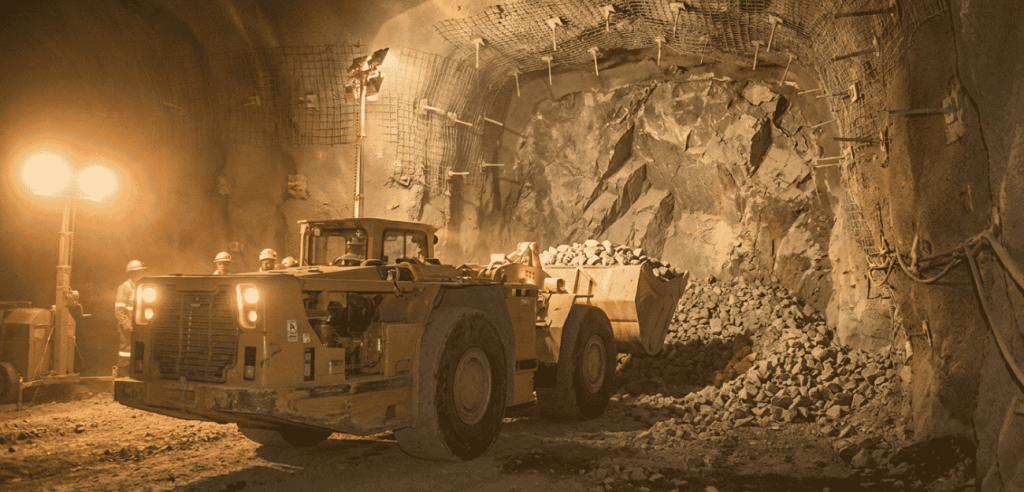
An LHD (Load, Haul, Dump) machine works most efficiently when it can penetrate a well-fragmented muckpile smoothly. Large, interlocking boulders drastically reduce bucket fill factors and increase tyre wear, hydraulic strain, and fuel consumption.
Tampings do not magically make an LHD drive faster, but they do create the ideal muckpile conditions required for the operator to hit maximum tramming speeds with a full payload on every pass.
3. Protecting the Excavation Profile (Overbreak & Dilution)
While tampings are primarily used to prevent under-break (oversize), they also play a role in controlled blasting. When a blast is properly confined and the powder factor is accurately calibrated, the rock breaks cleanly along the designed perimeter.
Poorly confined blasts often require overcharging to compensate for energy loss, which can damage the surrounding rock mass (overbreak). This leads to increased scaling time, heavier ground support requirements, and waste rock dilution—all of which severely throttle production efficiency.
What Should Mines Actually Measure? (Production KPIs)
Procurement departments often evaluate tampings based solely on unit cost. However, a cheaper, less effective tamping product that causes irregular fragmentation will cost the mine exponentially more in lost production.
To evaluate the true ROI of a tamping product, production teams should track the following underground KPIs before and after implementation:
- Oversize Percentage: A visual or automated analysis of the muckpile to track material exceeding the primary crusher’s maximum feed size.
- LHD Bucket Fill Factor: Are operators consistently achieving 90-100% capacity per scoop, or are they struggling to penetrate the pile?
- Secondary Breaking Frequency: The number of shifts interrupted by the need for mechanical rock breakers or secondary explosives.
- Advance Per Round: Comparing the drilled depth versus the actual pulled depth of a development heading.
- Mucking Time per Heading: A direct measurement of how long it takes to clear a standard blast volume.
Clarification: Do Tampings Reduce Post-Blast Gases?
A common misconception is that tampings eliminate hazardous post-blast fumes (like NO and NO2). This requires technical clarification.
Tampings are designed to confine the explosive charge to prevent the premature venting of blast energy. While proper confinement ensures a more complete and efficient chemical detonation (which can naturally reduce the volume of toxic fumes generated by poor detonations), tampings do not replace underground ventilation systems.
Mines must always adhere to statutory re-entry times and ventilation protocols, regardless of stemming performance.
OGM Supplies: Specialist Solutions for Underground Operations
Because underground mining operates in high-stress, cyclical environments, consistency is everything. Blasting crews cannot afford to use loose drill cuttings or inconsistent substitute materials that vary in moisture and frictional resistance from hole to hole.
OGM Supplies, based in Vereeniging, South Africa, manufactures specialist tamping products explicitly designed for the rigorous demands of underground blasting.
Whether an operation requires OGM Caps (a cartridge-format dolomite product for fast, consistent loading) or Kgwahla (a specialised dolomite-bentonite compound), selecting a purpose-built consumable ensures that explosive confinement remains a controlled, reliable metric across every shift.
Frequently Asked Questions
How do tampings reduce secondary breaking?
By sealing the blast hole, tampings trap high-pressure gases long enough to fracture the rock in the collar zone (the top of the hole). Without this confinement, the gas vents harmlessly into the air, leaving the collar rock intact as massive oversized boulders that require secondary mechanical breaking.
Will better tamping speed up my LHD loading times?
Yes, indirectly. While it doesn’t change the mechanical speed of the machine, effective tamping creates a uniformly fragmented muckpile. This allows the LHD bucket to penetrate the rock easily, achieve a higher fill factor on the first pass, and drastically reduce the time spent wrestling with poorly broken rock.
Can tamping help improve development advance rates?
Yes. Proper confinement ensures that the explosive energy works both radially (fragmentation) and longitudinally (heave/pull). Well-tamped blast holes are more likely to pull to their full drilled depth, ensuring maximum advance per round.
Why are manufactured tampings better than drill cuttings underground?
Drill cuttings are essentially fine dust. Under extreme explosive pressure, dust acts like a fluid and blows out of the hole instantly. Manufactured tampings (like dolomite-based capsules) provide high frictional resistance, locking into the borehole walls to hold pressure for the critical milliseconds required to break solid rock.